I changed the picture at the top of the site this week, with this great old view looking along Market Place. Our friend and fellow contributor John Taylor got in touch with us asking if we could try and find the same view but taken in the 1960's, and showing Cables Shoe Shop on the corner. I've had a look at what we've got, checked on Tameside Archives but had no luck..... John as looked on numerous web sites but as never come up with anything taken from this angle. So if you have one at the back of your draw or in your collection I'd love to be able to show it on here and make John's day
HYDE CHESHIRE
Harry Rutherford's
Festival of Britain Mural
Saturday, 15 September 2012
Friday, 14 September 2012
Godley Turntable Revisited
Just like the trains now.. we wait ages for a picture of the turn table and then two turned up.
We recently showed another picture from around here and now we have Eric to thank for sending this one in... It shows how busy this junction must have once been. "Enjoy"
Thursday, 13 September 2012
The Murder of Mr Thomas Ashton
On January 3rd 1831 Thomas Ashton was shot dead
as he made his way from his home at Pole Bank to Apethorn Mill. This was a story
I vividly remember reading in 'The History of Hyde' when I was very young.
The gate posts are just about all that's left now of the mill
'The History of Hyde' contains a chapter on the murder of
Thomas Ashton and the subsequent efforts to bring the persons responsible to
justice. The following report is from the Stockport Advertiser of January 7th,
1831 headed 'HORRIBLE MURDER':
'On Monday last one of the most cruel and sanguinary murders
which ever disgraced a civilized people, was perpetrated on the body of Mr.
Thomas Ashton, eldest son of Samuel Ashton, Esq., of Pole Bank, Werneth, in
this parish, so early as seven o'clock in the evening. The victim of this
cold-blooded and diabolical act of assassination, who was in his 24th
year, and remarkable for his kind and conciliating disposition and manners, had
the management of a new mill belonging to his father at Woodley, from whence he
had just returned and was on his way to the other mill at Apethorn to superintend
for his younger brother, James, who had just left home to spend the evening
with a family near Stockport. The father and mother were in the house at the
time waiting the return of the carriage to join the brother and the other part
of the family who had gone with him, and the effect of so distressing a
communication may more easily be imagined than described. It appeared on the
examination of the witnesses before the coroner that the unfortunate gentleman
had not proceeded on the public highway, after quitting the private road, which
leads from Pole Bank to Apethorn Mills, more than 30 yards, before he was shot;
and it would appear on examination of the premises about the fatal spot that
the assassins had awaited his approach, sitting behind a hedge bank on the road
side, which situation gave them the best opportunity of seeing or hearing the
approach of their victim from his father's house down the private pathway. The
breast was perforated at the edge of the bone by two bullets from a horse pistol
or blunderbuss, which had passed out at the left shoulder blade , having taken
an oblique direction upwards. His death must have been instantaneous, for when
found his right hand was in his greatcoat pocket – a manner of placing it quite
usual with him when walking. He was lying in a shallow ditch on the contrary
side of the road to the one generally taken by the family when going to the
mill, and this is accounted for by the supposition, that he must have retreated
to the other side when approached by the assassin in order to avoid him. The
muzzle of the weapon appears to have been placed close to his breast, as the
wadding perforated his garments, and part of it – some coarse blue paper – had
entered his body, and was concealed in the sternum. Other parts of it – some
white adhesive plaister – which had covered the balls, having been folded four
times, had not entered the body, but was removed with the clothes; and the use
of this extraordinary material will, in all probability, lead to the detection
of the villain.'
A reward of £500 was offered by his father, Samuel Ashton, together with £500 by other relatives of the
deceased, £500 by the Master Spinners of the district, and 'a promise of a
pardon from the King, to any one of the three suspected persons who would give
evidence; unless such person was the one who actually fired the shot'.
The scene as it is today
Despite a confession from 'a mad Scotsman' and a statement of complicity from another
'foolish individual' the mystery continued to defy solution, until in April 1834
a man in Derby gaol made statements likely to throw light upon the matter. The
statements led to the arrest of two men in Marple and on May 5th, 1834
three men – James Garside, Joseph Mosley and William Mosley were commited for
trial. Before the day of the trial arrived it became known that William Mosley
had turned King's evidence.
At the trial William Mosley had this to say about the
murder:
'A short space afterwards there came a man down the footpath
towards the clap gate. The man was in the footpath leading from Mr. Ashton's.
Garside got up, and met him in the field before he got through the gate, and
pointed the piece at him. He gave way. Garside fired. When Mr. Ashton gave way
he only went a little out of the way. Garside met him, and he went back. He had
got through the clap gate when he fired, and was going along the road to the
mill. The man who was shot fell across the road, with his head towards the
right hand side, opposite to where I was. We immediately ran away, and I made
the best of my way across the fields to the second canal bridge.'
Despite Garside trying to throw the blame onto Joseph
Mosley, and Joseph Mosley denying any knowledge of the crime they were both
found guilty and sentenced to hang. Garside had been the man in Derby gaol who
gave the information hoping to blame his accomplices, but the judge and jury
chose to believe William Mosley's account. The execution took place on November
25th, 1834 at Horsemonger Lane gaol in London.
The History of Hyde:
'The exact spot where Mr. Ashton fell was kept visible for
years by the workpeople scraping their feet over it when passing, and thus
preventing the grass growing there. Mr. Samuel Ashton subsequently had a number
of stones embedded in the ditch to mark the place, and also planted over it an
ash tree, to stand as a memorial of the tragedy.
A hundred years have rolled by since the murder, and the
loneliness of the spot where the crime took place has now disappeared. Mr.
Samuel Ashton erected two cottages close to the spot where the private path
from Pole Bank joined Apethorn Lane. In the second decade of the 20th
century Miss Ethel Dowson erected two other cottages on the opposite side of
the lane, and the garden gate of the one nearer Gee Cross is within a yard of
the place where the murdered man fell. The exact spot in which Mr. Ashton's
body was found is now marked by a grid. When the property higher up the lane
was erected in 1927-8, the hedge and ditch with the memorial stones and the
solitary ash tree, were removed, and the land added to the road.'
The cottages erected by Ethel Dowson. The grid on the corner in front of the green bins is, if its position has not been altered in the intervening years, where Thomas Ashton's body was found.
As to the reason for the shooting, 'The History of Hyde'
says: 'The crime was rightly regarded as an attempt, on the part of the
extremists in the trade union movement, to terrorise the employers', and in his
evidence William Mosley says that when they met up again he asked Garside which
of the Ashtons he had shot and was told that: 'it didn't matter which it was;
it was one of them.'
Samuel Ashton, his father, died 13 March 1849 aged 75
Wednesday, 12 September 2012
National Heritage Weekend - Flowery Field Church
You can tell by the lack of leaves on the trees that this photograph wasn't taken this weekend
The Flowery Field website says this about the building of the church:
'Work commenced on the building of the Church in 1876.
Thomas Worthington FRIBA of Manchester was commissioned to be the Architect. The building is in the Perpendicular or Tudor Gothic style of architecture and is cruciform in shape. There is a separate though connected Tower which rises 81 feet above street level. Work was finished towards the end of 1878 and the Opening Ceremony was held on Thursday 19th December 1878.
Following the Opening Service a SoirĂ©e was held in the "Flowery Field Educational Institute" better known today as "the School". At this meeting Mr. Ashton handed over the Trust Deeds of the Church to the Church Officers and also returned the sum of £1000 raised by the congregation, on condition that the money be invested and the interest used to augment a Minister’s stipend.
Thus, by this magnificent gesture, Thomas Ashton actually built the Church at his own expense, handing it to the congregation as a sacred trust and responsibility.'
To the left as you go through the main door, on the wall of the vestibule formed by the church tower, there is a brass plaque dedicating the church to Thomas Ashton and his wife, Elizabeth.'
And amongst the various documents, photographs and other items on display on the open day was this illuminated address given to Mr and Mrs Ashton at the opening of the church.
This is a photograph of the interior of the church from the gallery at the rear.
The church has several striking stained glass windows
The part of the transept to the right in the previous photograph contains the war memorials and this window.
The other side of the transept is the childrens' corner which contains a small altar and this window.
There are three sets of four stained glass windows behind the altar, apparently representing the twelve Apostles. There are names beneath the two bottom ones in each set of four, but the top six don't appear to be named.
Saint Bartholomew and Saint Philip at the bottom
Saint Matthew and Saint Simon at the bottom, Saint Peter on left above
Saint Thomas and (what appears to say) Saint James Minor at the bottom, Saint Andrew on left above
And finally another view of the interior looking towards the tower end of the building from the transept at the childrens' corner.
Labels:
Churches,
Flowery Field Church,
Heritage Open Days
Tuesday, 11 September 2012
National Heritage Weekend - St Thomas the Apostle
The leaflet for the Heritage Open Days issued by Tameside Council says this of the Church of St Thomas the Apostle in Lumn Road, Hyde:
'Grade II listed church built in 1868, of brick and stone, by Architect Medland Taylor of Manchester. The roof is unusual in that the architect created a double or extra pitch to the lower elevation. The building is blessed with magnificent stained glass windows by Bourne Jones/William Morris (I think they mean Burne-Jones). The church will be displaying full priest robes and photographs of Priests, May Queens, Servers and more. It is hoped to have information on the Chartist Movement and St Thomas.'
Nancy published a post about the church on 15 April 2011 but I took the opportunity to go and take some interior shots.
View of the interior
The South Window
In the War Memorial Window both figures were designed by Henry Dearle for St Lawrence Church, Bradfield, Essex, to which William Morris & Co supplied a window in 1919. The figure of St George was used in 6 places between 1919 and 1922, and always in War Memorials. The figure of Salvador Mundi was used in at least 15 places and not always in War Memorial windows.
The North Window
The figure of St Thomas was designed for a window of 1874 in Calcutta Cathedral and appears in 6 places in the UK. In the window in Calcutta, St Thomas is shown facing the viewer's left, but in Hyde it has been reversed mirror-wise so as to face right and in two other places (Brighton College Chapel and St Mary Dundee) the figure faces right and has been given a beard. The figure of St Hilda in the Hyde window was a versatile one. It was used originally in 1876 in Paisley Abbey, to represent Salome; but it was also used to represent Eunice, St Anne, Devotion, Phoebe and St Hilda in Hyde and Shrewsbury; but only in Hyde was it modified by the addition of a pastoral staff. The staff does not appear anywhere else.
The East Window
In the East window the figure of Christ as Love is a design which first made its appearance in 1895 in Albion Congregational Church, Ashton-under-Lyne. This Burne-Jones figure makes over 20 appearances in churches up and down the country.The figure of Mary makes at least 25 appearances mainly at representations of the crucifixion.
I am indebted to the website of St Thomas the Apostle for the information about the stained glass windows.
I noticed that this statuette of St Thomas was holding a carpenter's square and checked to see what reference there was to him being a carpenter. I found the following:
'In portraits St Thomas often holds a book as a sign of his apostolate. His primary attribute is most often a carpenter's square or T-square. This refers to the first episode of the Acts of the Holy Apostle Thomas where the apostles draw lots to see who will bring the gospels to what countries. When St Thomas draws India, he is reluctant to accept this difficult mission, but Jesus settles the issue by selling him to a royal official just arrived from India looking for a slave skilled in carpentry.'
Two statuettes of Mary and the infant Jesus
And lastly, at the Church of St Thomas the Apostle you don't have to climb a lot of steps up a tower to see the church bell. It's conveniently placed outside the building, though you would need a ladder if you wanted to see it up close!
Labels:
Churches,
Heritage Open Days,
St Thomas the Apostle
Monday, 10 September 2012
St Georges Cub Scouts
4th Hyde Cubs football team. (St Georges)
This picture was sent in by 'Mo', who thinks it would have been taken early 80's so if anybody recognises themselves they could perhaps date it
Can you put names to the faces?
Sunday, 9 September 2012
Hyde Waterworks --- a brief history
Waterworks were established in Hyde by Thomas Mottram, the descendent of an old yeoman family of the township, who in 1831, obtained an Act of Parliament "for the better supply of water to the several townships of Hyde, Werneth and Newton," and under the powers of that Act constructed the Gee Cross reservoir, Tinker's reservoir, New reservoir and Arnold Hill reservoir. The first three of these being known as "Queens" (later as Queen Adelaide), "Stonepit" and "Diamond Reservoir". Godley reservoir was constructed later in the 1850's.
In 1891 the supply of water from the Gee Cross reservoirs was declared unfit for domestic consumption owing to contamination, and this water was then used for manufacturing use only. The Arnold Hill reservoir, however was utilised for storing the Manchester Corporation water, and the pumping station was erected in 1893 to force the water into it. Meanwhile Newton had only a private supply, but in 1908 the Corporation decided to erect additional pumping plant, and constructed in Joel Lane the storage reservoirs known as "Hillside" and "Werneth", which were completed in 1911. In 1920 the Corporation acquired from the trustees of C & J Ashton, their Newton water supply, which included the reservoirs known as "Newton House" , "Blue Bell" and "Harbour". The property which these reservoirs supplied was disconnected in 1922, and supplied by town's water. The whole of the property within the borough , except a few isolated farms, was then supplied with town's water. The area between the Clarke's Arms, Stockpot Rd and the Goodiers, Victoria St, Newton, is supplied by gravitation from the Hoviley and Godley sources. Gee Cross and Newton are supplied by water pumped into the Gee Cross storage reservoirs, and then by gravity. The Newton service reservoir was constructed in 1928, and opened on Feb 19th, 1929, by the Mayor, Councillor A. Shaw J.P.
The large reservoir and waterworks of the Manchester Corporation at Tetlow Fold, Godley were constructed in 1850.
The above is from Thomas Middleton's "History of Hyde"
The photo's below show the Queen Adelaide reservoir in Gee Cross undergoing some reconstruction work probably around the early part of the 20th century.
Saturday, 8 September 2012
Day Trip Blackpool (2)
Colin's picture showing the ladies trip to Blackpool in the 1930s which we showed a week or two back seemed a popular one so I was pleased to see another one in our emails this week. This was taken on the same day as the last one... sometime in the 1930s
Rough Seas At Blackpool
Make's you want to stroll down the prom and take in the fresh air..
Friday, 7 September 2012
The Great Flood of 1906
There have been four previous posts about the Great Flood of 1906 and I've been passed a postcard by Ann and Bill Stones showing some of the damage caused by the flood to the roadway at Bottom Street in Newton.
Bottom Street runs off Commercial Brow at the side of the building which used to be the Commercial Inn and is shown on the map below.
This is what Bottom Street looks like now
'The History of Hyde' contains a graphic description of the Great Flood and the following extract tells of the effect it had on Bottom Street:
'The principal destruction was along the course of Wilson Brook and its tributaries. The first works to be seriously affected were the Godley Mills – the Leather works of Messrs. James North and Sons. On these the flood burst with fury, windows and doors were smashed in; and over £1,000 worth of goods swept away; the offices and store-rooms were undermined, and in a few minutes the whole of the building for a distance of twenty yards collapsed, whilst a good portion of the road in Bottom Street was torn up. Mr. George North, one of the principals of the firm, had to swim for his life, being entrapped by the water whilst leaving the cellar.
In Bottom Street the water washed into the houses at great speed, and in a few minutes the inhabitants had to take refuge in the bedrooms, whence they were afterwards rescued by ladders from the bedroom windows. Furniture was tossed about and broken to pieces, and numerous articles floated through the broken doors and windows, and were carried off on the surging torrent.'
The back of the postcard is interesting:
The cost of postage is printed on the card as a halfpenny. It's now 60p and there are 144 old pennies in 60p, so you could send 288 of these postcards in 1906 for the price of one first class stamp today.
Thanks to Paul for these pictures
Labels:
1906,
Bottom Street,
Flood,
Newton,
Postcards
Heritage Open Day At St Georges
Muriel Nichols has contacted us to say that tomorrow 9th September is Heritage Open Day at St Georges Church, doors open from 9--5. Once again some changes and new items from previous years. This year old framed photos of St George and St Luke's Dukinfield can be viewed. There is also a signed photo of 'William Garside Phillips Esq JP, of Ansley Hall, Nuneaton Warwickshire, formerly a scholar and secretary of St George's Sunday School and a liberal supporter of St George's for the past sixty years.' This is written on the mount. The date is 1923. Some of these items saved by Church members need better care and some restoration but it is fortunate they are saved.. Please come and photograph it and see what else has turned up like some old framed photos of St George's and St Lukes Dukinfield.
If people could bring any old picture frames they can't use, as Muriel as things for both Church and Theatre in need of them, just to stop them getting spoiled.
Muriel Nichols
Thursday, 6 September 2012
Thomas Middleton
My copy of 'The History of Hyde' is one which I inherited from my late father, and on the flyleaf is pasted this cutting from, presumably, the North Cheshire Herald. There's no date on it and I can't find the date of Thomas Middleton's death, but it was obviously some time after 1950.
I notice that the photo is credited to Searle's who also took the photograph of the 1904/05 Mayor of Hyde, John Blackwell, as shown in a recent post.
Labels:
History of Hyde,
Mayor,
Thomas Middleton
Wednesday, 5 September 2012
Newton Cricket Club
Our thank to Colin Critchlow for today post
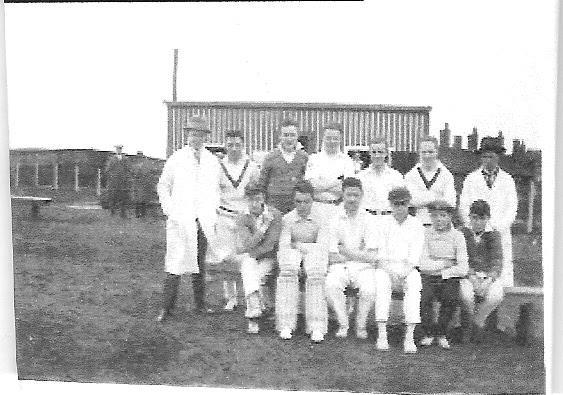
Newton C.C. Around 1935
On the photo are Dad top right, My Uncle Eric Higginbottom, Sam Gregson, Secretary Mr J Heaton and Hydes future Mayor Mr Leech.
I asked Colin if he could supply some information, his reply....
I would be glad to assist you with some information regarding the history of Newton Cricket Club and my family's involvement
The club celebrated its centenary this year after being formed in 1912.
I believe the club played its first matches on a ground adjacent to Clarendon Road, Hyde.
The club moved to their present ground at Barmhouse Lane, Godley in the 1920s.
My Uncle Eric Higginbottom had long connections with the club, and his father before him may have been involved from the very beginning.
My first visit to the club was in 1936 in the pram watching Dad (Bill Critchlow) who was a notable cricketer for the club for many years open the bowling.
During the war years my cricket visits were put on hold since Dad was sent to India but he did manage to represent the British Forces team against an Indian eleven
before being posted to Burma.
Having played in the Stockport league Newton found themselves in the Hyde and district league finishing champions followed by a number of years in the Denton and District league
which again proved to be a very successful period.
I was lucky enough to be the scorer for a two seasons before playing myself
Newton organised a junior team in 1951 which created a lot of interest. Lads like myself, Neville Higginbottom and Michael Bent had been at the club all our lives since our Dads
were ex players and still active members at the club.
During the week the farmers cattle were allowed on the outer field so we had quite a job getting the area ready for the weekend match which usually meant a Friday night clearing up job
and preparing the wicket area which thankfully was protected by a fence.
There was a deep dip in one corner of the ground which our President Mr Alfred Rushton made arrangements to fill in which proved to be a major task.
The club moved on to the Glossop league were they played a number of years before joining the High Peak league where they managed to finish champions after a thrilling win at Trinity Meths.
It was then back to the Glossop league and finally where they are now in the Derbyshire and Cheshire league.
Newton have been fortunate to have had many good cricketers over the years, and once in the early days they had one Len Hopwood in their ranks who would go on and represent both Lancashire and England
I was lucky enough to meet Len at our annual dinner dance when he presented the prizes.
The ladies were always a very important part of the club and it was my good fortune to know so many good people such as Alf Rushton, Arthur Bent, Mr and Mrs Hiram Tagg, and Sam Gregson who always gave us encouragement.
Finally last but not least is a fellow who was the heart and sole of the club and represented everything good about it, his name was Eric Howath.
Newton C.C. 1948
Newton C.C.
1953 Champions
Denton & District League
E Howarth, S Gregson, H Tagg, and F Wrigley
Newton C.C. Ladies 1954
Newton C.C. Around 1963
W. A. Critchlow
Newton C. C.
................................
By
Colin Critchlow
Subscribe to:
Posts (Atom)


+Cubs.jpg)